

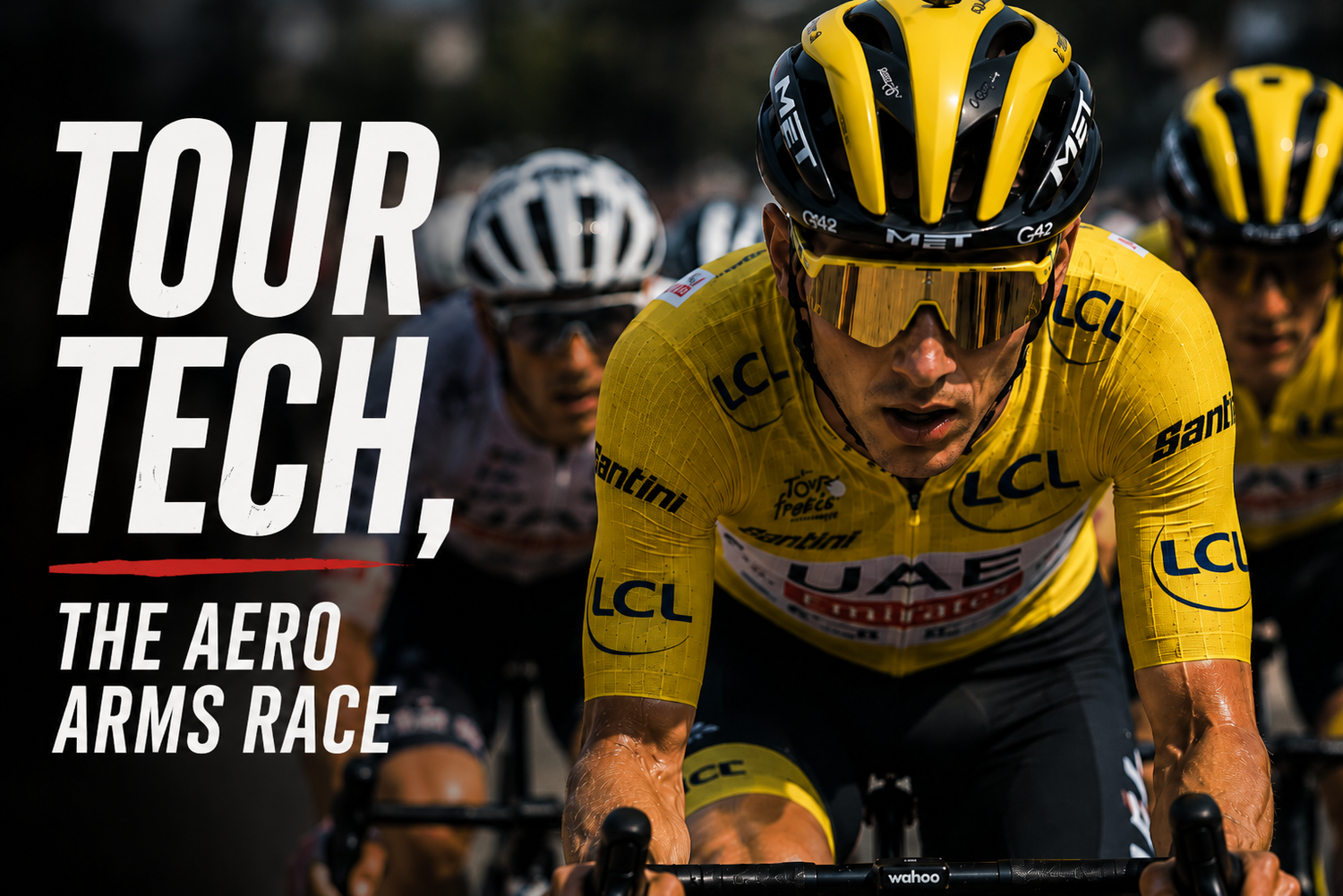
Every July, the Tour de France becomes more than the biggest bike race in the world.
It becomes a three-week testing ground for the future of cycling.
The riders may get the attention, but behind every breakaway, mountain attack and high-speed sprint is an enormous amount of technology. Teams are constantly looking for advantages through helmets, tires, clothing, bike fit and components that most fans may never notice.
At the 2026 Tour de France, the biggest story in equipment is not one revolutionary product.
It is the relentless pursuit of small gains.
Helmets Are Becoming Complete Aero Systems

For years, cyclists often had to choose between a lightweight, well-ventilated helmet and a faster aerodynamic model.
That line is beginning to disappear.
Modern aero helmets are being designed to reduce drag without creating the heat and weight penalties associated with older designs. Manufacturers now use wind-tunnel testing, computational airflow modeling and extensive rider testing to shape helmets around the way a cyclist actually sits on the bike.
New helmets from KASK and POC were among the equipment spotted at the beginning of this year’s Tour, while teams also experimented with small aerodynamic modifications and carefully covered openings around bikes and components.
The helmet is no longer treated as an isolated piece of protective equipment. It is becoming part of a complete system that includes the rider’s head position, glasses, shoulders, clothing and bicycle.
A helmet may perform extremely well in a wind tunnel, but its real value depends on how it works with the individual rider wearing it.
Personalization Is Becoming Part of Performance

One of the most interesting trends in professional cycling is how little of the equipment is truly stock.
Riders frequently adjust or replace sponsor-supplied shoes, saddles, pedals and other contact points to create a setup that fits their body and riding style.
Tadej Pogačar has used an individually specified 3D-printed saddle developed from pressure-mapping data. During this year’s Tour, he also appeared in a helmet featuring an AI-assisted visual design developed through a collaboration involving MET.
The saddle is designed around physical performance and comfort. The helmet design is about identity, storytelling and fan engagement. Together, they represent where cycling equipment may be heading: more technical, but also more personal.
At the professional level, teams are paying attention to details such as:
• Saddle pressure and shape
• Helmet position and airflow
• Shoe and cleat alignment
• Cockpit dimensions
• Clothing fit and fabric placement
• Individual riding position
Even when riders are part of the same team, their equipment needs may be completely different. That is why customization is no longer only about appearance.
It can become part of performance.
The Smallest Details Are Getting Serious Attention
The Tour is filled with components that may save only fractions of a watt.
That includes aero socks, waxed chains, integrated computer mounts, lightweight bottles, 3D-printed parts and pieces of carefully placed aerodynamic tape.
Some of those changes may look excessive. At the highest level of racing, however, multiple small improvements can add up to something meaningful.
A recent Tour technology gallery even highlighted narrower time-trial tires, oversized chainrings, 3D-printed components and a custom titanium computer mount on one of Pogačar’s bikes.
Not every innovation will become a mainstream product. Some exist only to solve a very specific problem for one rider, one bicycle or one race. But that experimentation is part of what makes the Tour so important. It shows us what manufacturers, mechanics and athletes are willing to try before those ideas reach the rest of cycling.
What Actually Matters to Everyday Riders?
Most cyclists do not need a professional race bike or an entire team of mechanics. But the thinking behind Tour-level equipment still applies.
A properly fitted helmet matters.
Correct tire pressure matters.
A comfortable saddle matters.
A clean and efficient drivetrain matters.
Equipment that works with your body will usually provide more value than equipment selected only because a professional uses it.
Some Tour-tested products are also becoming realistic upgrades for everyday riders. Wider performance tires, chain wax, aero helmets and better-fitting clothing can improve speed or comfort without requiring a completely new bicycle.
The goal should not be to copy a Tour rider’s setup. The goal should be to understand why that setup works and apply the same attention to detail to your own equipment.
The Birdworx Take
The biggest lesson from the Tour de France is not that everyone needs a $15,000 bicycle. It is that details matter.
At Birdworx, we have always believed equipment can be both functional and personal. A helmet protects the rider and can influence performance, but it is also one of the most visible expressions of a rider’s identity.
The future of cycling equipment will not only be lighter or faster.
It will be more individual. More intelligently fitted. More carefully designed.
And increasingly created around the specific person using it.
That is a culture we can get behind.
Make it your own.
